Smart Blinds That Reduce Heat in Sunny Rooms
How the right window covering can keep a south-facing room cooler without closing it off
Read this within a minute
What's the news?
- Solar heat gain through windows can account for a substantial share of cooling load in sunny rooms — the right blind, managed intelligently, may reduce that load significantly
- Smart automation makes the critical difference: a blind that adjusts automatically at the right time of day blocks heat at its source before the room warms up
- Honeycomb (cellular) blinds combine strong insulation properties with motorized automation, making them one of the most effective combinations for year-round thermal management
What you need to know
- Honeycomb blinds trap air in their cellular structure, creating an insulating barrier that works in both summer (blocking heat) and winter (retaining warmth)
- Motionblinds honeycomb motors support top-down bottom-up operation via dual motor — giving precise control over light levels and privacy alongside heat management
- Motionblinds motors can be set to run on timers that operate locally in the motor — no internet required, no app interaction needed once configured
- Full smart home integration via the Motionblinds Matter Wi-Fi Bridge adds automated scenes tied to time of day, temperature sensors, or voice commands
- Eve Motionblinds uses Thread — a local mesh network — meaning sun-blocking automation continues to work even during internet outages
- Solar panel accessories can power motors in the sunniest windows where heat reduction matters most — reducing battery recharging to near-zero in well-lit rooms
Key takeaways
- Heat reduction from smart blinds is not just about the blind itself — it's about when the blind moves. A blind that closes automatically at 10am in a south-facing room, before the room has warmed up, is far more effective than one that requires manual operation and gets remembered at noon.
- Motionblinds honeycomb blinds pair strong cellular insulation with intelligent automation — timers, smart home scenes, or voice control — for a solution that manages heat passively and consistently. For anyone with a sunny living room, home office, or conservatory that becomes uncomfortable in summer, this combination is worth considering closely.
Why smart automation changes the heat reduction equation
A blind does nothing for heat reduction if it's not closed at the right moment. The typical failure mode in a sunny room is familiar: the blind stays open because the morning light is pleasant, the room gradually warms, and by the time someone closes the blind it has already absorbed significant solar heat gain.
Smart automation changes this. A timer or sun-position scene closes the blind before peak solar gain — before the room heats up, rather than after. That shift from reactive to proactive is the single most effective thing a smart blind adds to heat management.
Combine that with the right blind material, and the impact compounds.
Honeycomb blinds: the strongest blind type for thermal performance
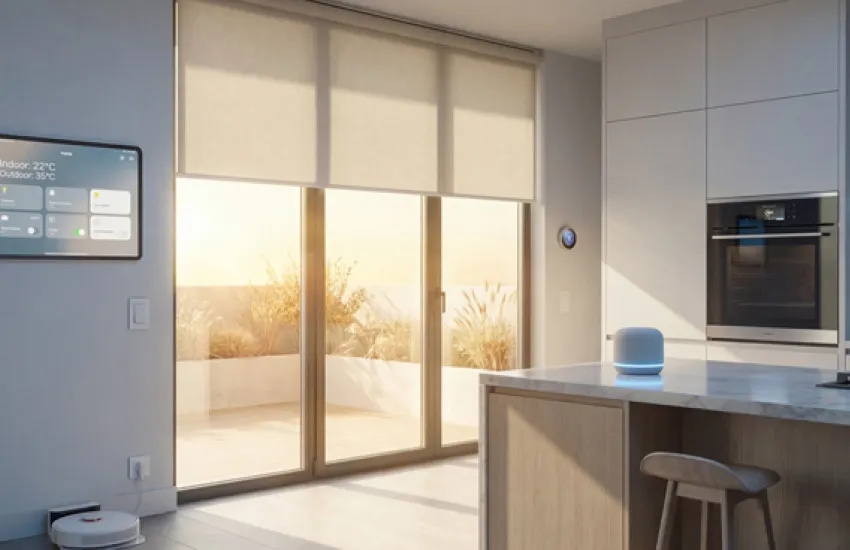
Honeycomb blinds — also called cellular blinds — are constructed with a distinctive accordion-like cell structure. Each cell traps a pocket of still air, which acts as an insulating layer between the glass and the room. In summer, this slows the transfer of solar heat into the room. In winter, the same structure slows heat loss through the glass.
The Motionblinds honeycomb motor range supports this structure with precise, quiet automation. Motionblinds honeycomb blinds are available with top-down bottom-up operation via dual motor — meaning you can lower the top portion of the blind to manage heat at ceiling level while keeping the lower section raised for a view. That level of control is genuinely useful in a room where you want thermal management without losing daylight entirely.
Discover the full honeycomb range at motionblinds.com/products/honeycomb.
How smart automation makes heat reduction consistent
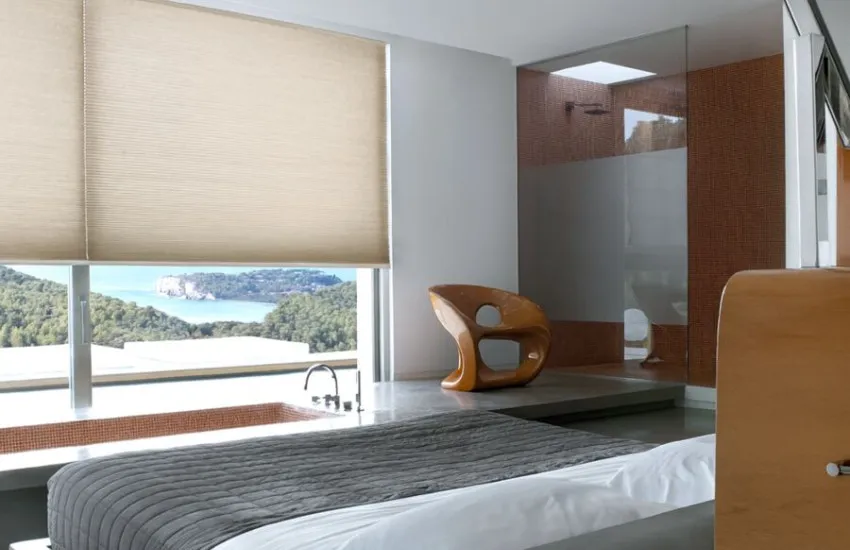
Motionblinds motors support up to 3 timers per motor at the Bluetooth level — programmed directly into the motor and running locally. No internet, no app, no cloud. Set a timer to close the blind at 9am and open it at 6pm on summer days, and it runs without any daily interaction.
Add the Motionblinds Matter Wi-Fi Bridge and the capability expands. Smart home scenes tied to time of day, temperature sensor readings, or sun position become possible via Apple Home, Google Home, Amazon Alexa, Samsung SmartThings, and Home Assistant. A scene that closes south-facing blinds when a room temperature sensor reaches a set threshold automates heat management without any manual oversight.
Eve Motionblinds takes this further. Matter and Thread are built directly into the motor — no separate Motionblinds Bridge device needed — and Thread operates as a local mesh network. Sun-blocking automation continues to run during internet outages. For a conservatory or home office where reliable temperature management matters, that resilience has real practical value.

Practical scenarios: where smart blinds make the most difference
South and west-facing living rooms are the classic use case. Morning and afternoon sun can raise temperatures significantly in summer, and without timed automation the blind simply doesn't get closed early enough. A Motionblinds timer set to close at 9am and reopen at 6pm handles this without daily thought.
Home offices present a related challenge. Glare on screens is often the first complaint, but by the time someone closes a blind manually the room is already warm. A smart blind set to a sun-position scene via Apple Home or Google Home closes automatically when solar elevation reaches a threshold — managing both glare and heat gain simultaneously.
Conservatories and garden rooms are the most acute case. South-facing glazing in a conservatory can make the space unusable on sunny days without effective solar management. The combination of honeycomb insulation, early morning automated closure, and a solar panel to power the motor in a high-sun location creates a genuinely practical heat management system that runs without intervention.

FAQ - Smart Blinds That Reduce Heat in Sunny Rooms
Yes — when used proactively. A blind that closes automatically before peak solar gain can significantly reduce how much heat enters a room. The thermal reduction potential depends on the blind material (honeycomb performs best), the timing of closure, and how much solar gain the window receives. Smart automation makes consistent early closure practical without daily manual intervention.
Honeycomb (cellular) blinds are the strongest performer for thermal management. Their cellular structure traps air in insulating pockets, slowing heat transfer through the glass in summer and retaining warmth in winter. Combined with smart automation for timed closure, they offer the best combination of heat reduction and light control.
Yes — when using the Motionblinds Matter Wi-Fi Bridge with a compatible smart home platform such as Apple Home, Google Home, or Home Assistant, automation scenes can be created that trigger blind closure based on temperature sensor readings. The specific capabilities depend on the platform used.
Top-down bottom-up is a feature on Motionblinds honeycomb blinds that allows the blind to open from the top, close from the bottom, or operate both simultaneously. This lets you manage solar heat gain at ceiling level while maintaining a view through the lower portion of the window. It requires a dual motor setup.
Yes — in two ways. Timers programmed into any Motionblinds motor run locally in the motor and operate without internet. Eve Motionblinds additionally uses Thread, a local mesh network, so full smart home automation continues to function during internet outages. In addition, Motionblinds has a pull feature, so you can always control your blinds manually at any time.
Honeycomb blinds generally perform better for thermal management due to their insulating cell structure. Roller blinds are effective at controlling light and glare, and black-out roller fabrics can also reduce solar heat gain meaningfully. For maximum thermal performance, honeycomb is the stronger choice.
Related blogposts