What features matter most when choosing smart blinds?
A clear guide to the features that shape comfort, control, and long-term performance
Read this within a minute
What's the news?
- In 2026, the best smart home window solutions revolve around motorized smart blinds that work flawlessly with major ecosystems — top features now include voice control, precise app control, scheduling, and silent motors.
- Matter over Thread has become the tie-breaking connectivity feature for smart blind purchases in 2026 — buyers who want future-proof integration across Apple Home, Google Home, and Alexa now prioritize it above all other connectivity features.
- Rising energy costs, increased work-from-home routines, and wider adoption of smart home systems are pushing window treatments into a new role — one where features like automation, energy management, and child safety matter as much as appearance.
What you need to know
- Connectivity protocol is the most important long-term feature — Matter and Thread native systems work across all major platforms without requiring a proprietary bridge device.
- Motionblinds offers three connectivity levels: Bluetooth app control, Matter Wi-Fi Bridge for full smart home integration, and Eve Motionblinds with Matter and Thread built in for the most advanced setup.
- Motor noise directly affects daily comfort — Motionblinds motors run up to 15 dB quieter than standard motorized systems, making them suitable for bedrooms, nurseries, and home offices.
- Power source shapes installation complexity — USB-C rechargeable battery motors require no hardwiring and suit most residential retrofits, while hardwired motors are the right choice for high-use or commercial installations.
- Battery life for smart blinds typically lasts 6–12 months on a single charge depending on usage, with USB-C charging allowing convenient recharging.
- Automation features — scheduling, voice control, and scene integration — are what separate a motorized blind from a genuinely smart one.
- Child safety is now a baseline expectation — cordless operation and secure mounting hardware are features to verify before any purchase.
Key takeaways
The right smart blind features depend on how you live in your home — your smart home ecosystem, your daily routines, the rooms involved, and whether safety is a priority. A feature that matters enormously in a nursery may be irrelevant for a home office. Understanding which features solve your specific problems is more useful than chasing the longest spec list.
This guide is for homeowners and renovators evaluating smart blind options for the first time or upgrading from a basic motorized system. It cuts through the feature noise and focuses on what genuinely makes a difference in daily use — and where Motionblinds delivers the strongest combination of all of them.
Why features matter more than brand name
The smart blind market has matured significantly in 2026. Motors are quieter, battery life is longer, and smart home integration has become genuinely seamless for systems built on open standards. But with more options comes more complexity — and the features that matter most vary significantly depending on the home, the room, and the buyer.
Homeowner expectations are changing. Rising energy costs, increased work-from-home routines, and wider adoption of smart home systems are pushing window treatments into a new role. A blind that opened and closed reliably was sufficient five years ago. In 2026, buyers expect their window coverings to integrate with voice assistants, respond to temperature changes, follow sunrise and sunset schedules, and operate silently in every room of the home.
The features that deliver on those expectations are specific and identifiable. Motor noise, connectivity level, power source, automation capability, and safety design are the five areas that determine whether a smart blind system performs effortlessly every day — or becomes a source of frustration. Understanding each one before buying is the difference between a system that genuinely improves daily life and one that mostly just opens and closes on a schedule.
Connectivity — the feature that decides everything else
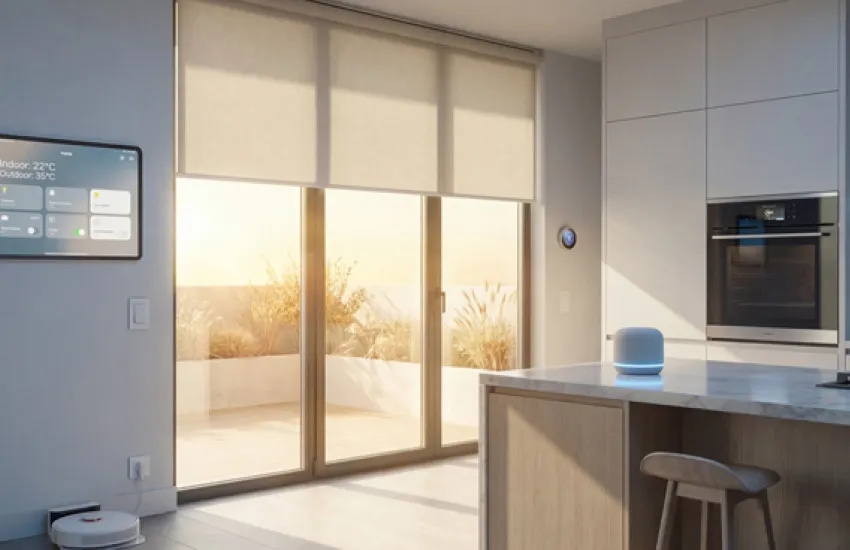
Connectivity is the single most important feature to evaluate when choosing smart blinds — because it determines which smart home platforms the system works with, how reliably it responds to commands, and whether it stays compatible as technology evolves.
Motionblinds offers three connectivity levels to match different home setups and budgets. Understanding which level fits your needs is the first decision to make.
Bluetooth is the entry level — app-based control within Bluetooth range (approximately 10 metres), with up to three timers per motor and no internet required. It's the right starting point for buyers who want simple automated control without smart home integration. It does not connect to Alexa, Google Home, or Apple Home.
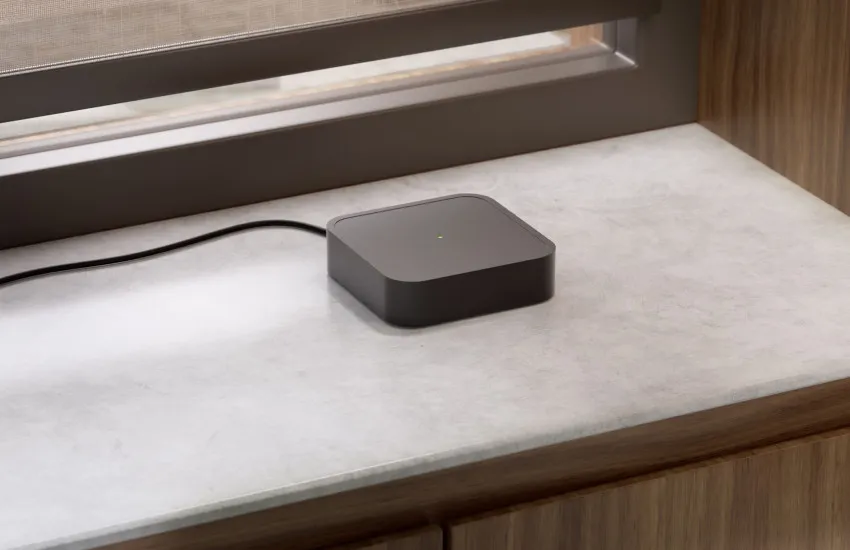
Matter Wi-Fi Bridge is the mid-level — adding the Motionblinds Bridge device unlocks full remote access from anywhere and integration with Apple Home, Google Home, Amazon Alexa, Samsung SmartThings, and Home Assistant. For most homeowners who want full control, this is the practical choice.
Eve Motionblinds is the most advanced level — Matter and Thread are built directly into the motor, enabling native integration with Apple Home, Google Home, Amazon Alexa, and Samsung SmartThings without the Motionblinds Bridge. Eve Motionblinds motors operate on Thread, a local mesh network that keeps blinds running even during internet outages and delivers faster response times. A compatible smart home hub from your preferred platform is required — but no Motionblinds Bridge is needed. This is the right choice for buyers who want the most future-proof, platform-flexible setup available.
Matter over Thread is now the tie-breaking standard in 2026 — systems built on it stay compatible as smart home platforms evolve, without requiring hardware replacement.
Motor noise — the feature most buyers underestimate
Motor noise is consistently underestimated at the research stage and consistently noticed once a system is installed and operating every day. A blind that raises and closes with a loud mechanical whir in a bedroom, nursery, or home office is a quality problem that no amount of smart home integration can fix.
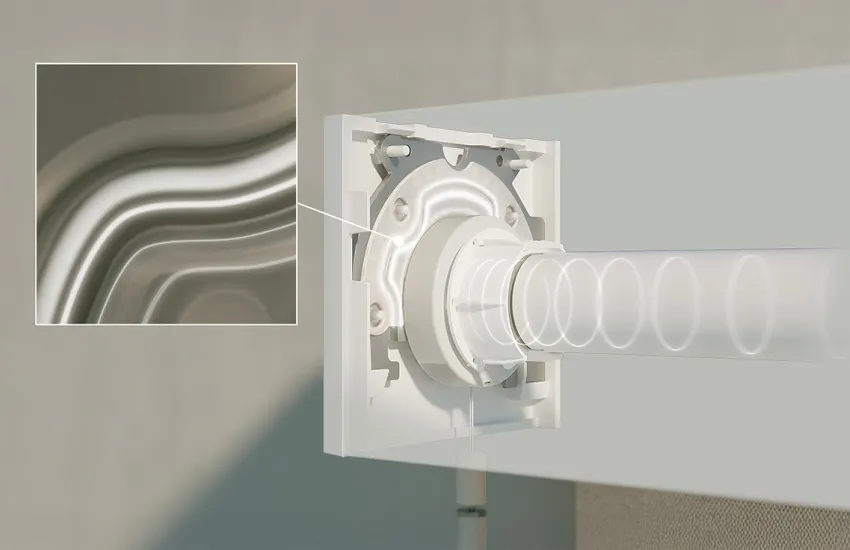
Silent motors are now among the top features homeowners prioritize in 2026 — and the difference between a quiet motor and a standard one is measurable, not subjective. Motionblinds powered systems run up to 15 dB quieter than standard motorized systems. Combined with precision soft start and stop mechanics, movement is gradual and non-alarming — important for nurseries, light sleepers, and homes with noise-sensitive pets.
The practical test when evaluating any motor: would you be comfortable with this sound activating at 6am in your bedroom, or during a video call in your home office? If the answer is uncertain, the motor is not quiet enough. Motionblinds passes that test comfortably — and the 15 dB reduction over standard systems is significant enough to be immediately noticeable in real-world use.
Power source — matching the right option to your home
Power source determines installation complexity, long-term maintenance, and the practical reality of owning the system over several years. There is no universally correct answer — the right choice depends on the room, the window size, and how the home is set up.
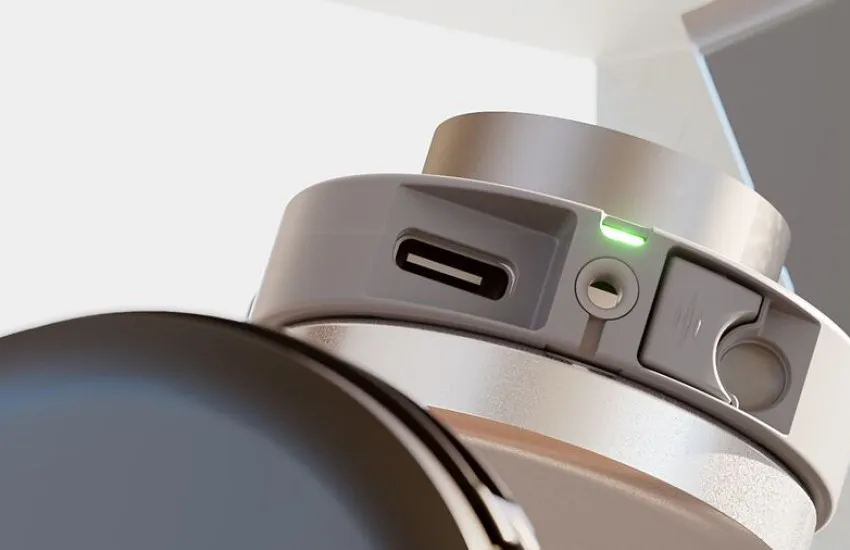
Battery power is the simplest and most popular option. A built-in rechargeable battery powers the motor with no need for an electrician, and installation is a simple DIY project. Battery life typically lasts 6–12 months on a single charge depending on usage, with USB-C charging allowing convenient recharging. For most residential retrofits — living rooms, bedrooms, home offices — USB-C rechargeable battery motors are the practical first choice. Motionblinds USB-C battery motors last months between charges under normal use and recharge quickly without requiring any wiring.
Hardwired motors are the right choice for high-use environments — large windows that move multiple times daily, commercial applications, or whole-home installations where recharging many motors is impractical. Motionblinds offers both battery and hardwired options across its full motor range, allowing the right power solution to be matched to each window's specific demands without compromising on connectivity or motor quality.
Solar options extend battery life on sun-facing windows without additional infrastructure — a practical choice for south and west-facing windows that receive consistent direct sunlight and would otherwise need more frequent recharging.
Automation and smart home integration — where smart blinds become genuinely useful
A motorized blind that responds to a button press is convenient. A smart blind that opens automatically at sunrise, closes when a room begins to overheat, adjusts for a movie scene, and moves to a privacy position when you leave the house is genuinely useful — and the difference is automation depth.
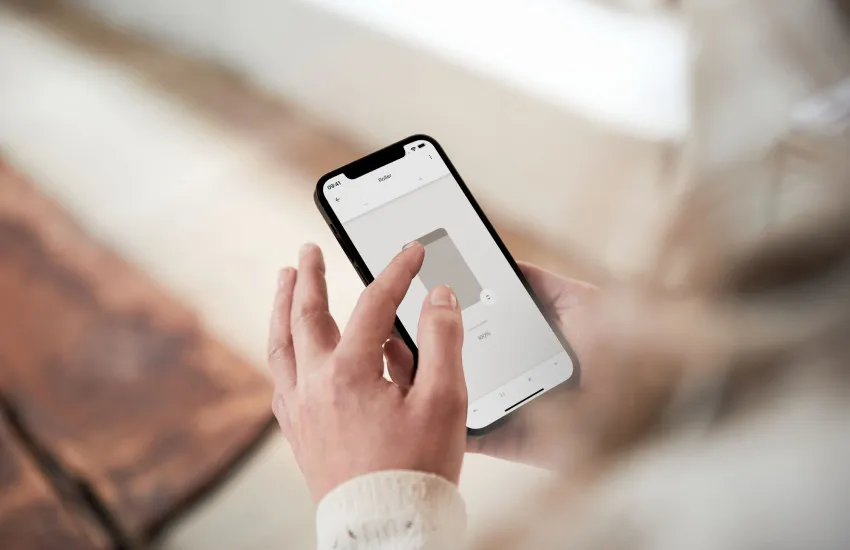
Smart blinds simplify your daily routine by allowing you to automate their operation — schedule opening and closing times, set preferences, and enjoy the convenience of hands-free control. But the automation features worth evaluating go beyond basic scheduling. Temperature-triggered closing, sunrise and sunset scheduling, voice scene integration, and group control across multiple windows in the same room are the features that make a smart blind system earn its place in a connected home.
With the Matter Wi-Fi Bridge, Motionblinds integrates with Apple Home, Google Home, Amazon Alexa, Samsung SmartThings, and Home Assistant — enabling advanced automations, scenes, and voice control. With Eve Motionblinds, all of this is available natively via Matter and Thread, with the added benefit of local operation that runs reliably even without internet. Scenes like "Good Morning" (all blinds open gradually), "Movie Time" (living room shades close to 70%), and "Away" (all blinds to a privacy position) run from a single voice command or tap.
Advanced features like scheduling, scene creation, and geo-fencing expand automation possibilities, making window treatments smarter and more adaptable to your lifestyle. Geo-fencing — blinds closing automatically when you leave the house and opening when you return — is available through Apple Home and Google Home integrations with Motionblinds, and represents the kind of genuinely effortless automation that makes the investment worthwhile.
Safety, fabric, and the features that complete the picture
Two further features deserve attention before any smart blind purchase — child safety design and fabric choice — because both have a direct impact on daily life that spec comparisons rarely capture adequately.
On safety, cordless operation is now the baseline legal standard in the US and Canada following the 2024 ban on traditional corded window coverings. But beyond cord elimination, the features that matter for family homes are secure mounting hardware with no loose or dangling components, and quiet operation that doesn't startle children or pets. Motionblinds motors are engineered with all of these features as standard — cord-free, securely mounted, and operating up to 15 dB below standard systems.
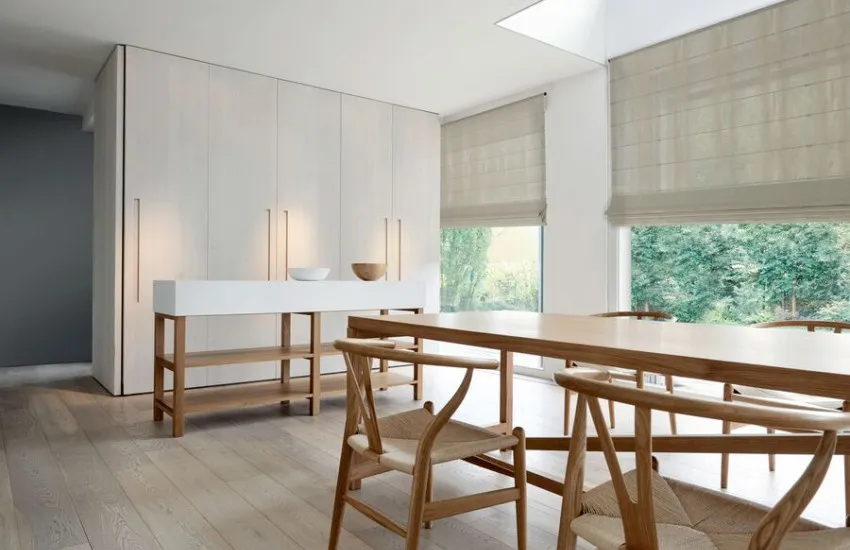
On fabric, the choice significantly affects both the daily experience and the long-term performance of the system. Black-out fabrics are the right choice for bedrooms, nurseries, and media rooms where complete light control is the priority. Light filtering fabrics suit living areas and home offices where natural light is desirable alongside privacy. Cellular and honeycomb fabrics deliver the strongest energy efficiency for rooms where temperature management is important. Motionblinds supports all of these fabric types across its full motor range — roller, roman, cellular, pleated, Venetian, vertical, curtain, and dual roller configurations — giving homeowners the flexibility to match the right fabric to each room without switching motor systems.
Frequently Asked Questions - What features matter most when choosing smart blinds?
Connectivity level is the most important long-term feature. Motionblinds offers three options — Bluetooth for simple local control, Matter Wi-Fi Bridge for full smart home integration with Apple Home, Google Home, Alexa, SmartThings, and Home Assistant, and Eve Motionblinds with Matter and Thread built in for the most advanced, future-proof setup across all major platforms.
It depends on the model. Standard Motionblinds Bluetooth motors use the Matter Wi-Fi Bridge for smart home integration and remote access. Eve Motionblinds has Matter and Thread built directly into the motor — no Motionblinds Bridge is required, just a compatible smart home hub from your preferred platform such as Apple Home, Google Home, or Amazon Alexa.
Battery life for smart blinds typically lasts 6–12 months on a single charge depending on usage and blind size. Motionblinds USB-C batteries last months between charges under normal residential use and recharge quickly — no hardwiring or electrician required for most installations.
Yes — provided the system is fully cordless. Motionblinds motors operate without any exposed cords or chains, meeting and exceeding the 2024 US and Canada requirements for cordless window coverings. Quiet operation up to 15 dB below standard systems also makes them suitable for nurseries and children's bedrooms.
Black-out fabrics block all incoming light — the right choice for bedrooms, nurseries, and media rooms where complete darkness is the goal. Light filtering fabrics diffuse natural light while maintaining privacy — the right choice for living rooms, kitchens, and home offices where natural light is desirable. Both fabric types are available across the full Motionblinds motor range.
Eve Motionblinds connects natively to Apple Home via built-in Matter and Thread — no Motionblinds Bridge required. Motionblinds Matter Bridge s support Apple Home, Google Home, Alexa, SmartThings, and Home Assistant via Matter-over-Wi-Fi.
Yes. Motionblinds is designed to be upgradeable. If you start with Bluetooth control, you can add the Matter Wi-Fi Bridge for full remote access and smart home integration. For the most advanced setup, Eve Motionblinds offers Matter and Thread.
Yes. The Motionblinds Upgrade Kit is designed to fit most standard roller blind tubes — adding a smart motor without replacing existing fabric or hardware. This is the most cost-effective path to a fully smart installation for most homes.
Related blogposts