How much do smart blinds cost?
What the leading brands actually charge, and why
Read this within a minute
What's the news?
-
Motorized blind pricing varies enormously by brand and installation type, with battery-powered DIY setups sitting well below professionally installed hardwired systems, according to HomeAdvisor.
-
Pricing tiers differ sharply by brand, from SwitchBot's budget-tier retrofit units to Hunter Douglas's luxury-tier made-to-measure shades, and the smart home integration story differs just as much as the price.
-
Matter and Thread adoption is uneven across brands: some, like Motionblinds and now SwitchBot's Hub 3, build it in natively; others, like Somfy, still don't offer native Matter certification across their range.
What you need to know
-
Hunter Douglas PowerView Gen 3 shades sit at the luxury end of the category, plus an additional gateway device, and now support Matter via a firmware update, though the brand remains design-first rather than smart-home-first.
-
SwitchBot's Blind Tilt is the lowest-cost entry point in the category and now pairs with a Hub 3 that supports Matter 1.3 and local Thread execution, but it only tilts existing horizontal blinds and cannot raise or lower them.
-
Lutron Serena sits in the premium tier with quiet, well-received motor performance, but uses a proprietary ClearConnect protocol with no native Matter support.
-
Somfy has the largest professional installer network in the US but requires its TaHoma hub for smart home integration, and has no native Matter certification across its motor range as of mid-2026.
-
Motionblinds sits in the mid-premium range with Matter and Thread built directly into Eve Motionblinds motors, avoiding the separate hub cost that Somfy, Lutron, and (for full functionality) SwitchBot all require.
-
The Motionblinds Upgrade Kit retrofits most standard roller blind tubes at one of the lowest price points in the category making it one of the lowest-cost paths to full automation.
Key takeaways
Price tier alone doesn't tell you what you're buying. The four brands competing hardest for this budget, Somfy, Hunter Douglas, SwitchBot, and Lutron Serena, each solve a different problem at a different price level, and none of them match Motionblinds on the combination of open connectivity and price positioning.
This article is for anyone comparing smart blind costs across brands, not just Motionblinds alone. It breaks down where each major competitor sits on price, what that tier includes, and where Motionblinds fits in that landscape.
Why comparing smart blind prices across brands is harder than it looks
A price tier only means something once you know what's bundled into it. Hunter Douglas's luxury-tier pricing is for a finished, made-to-measure shade with industry-leading fabric options, not a motor you can pair with your own blind. SwitchBot's budget pricing is for a retrofit device that only tilts slats on blinds you already own.
Somfy and Lutron Serena both sell in the premium tier depending on configuration, but both require a proprietary hub, TaHoma for Somfy, a Smart Bridge for Lutron, to reach full smart home integration. That hub requirement, plus professional installation, changes the real total meaningfully.
How to evaluate competing smart blind brands on cost
Four questions cut through most of the pricing confusion. Does the price include a finished shade or just a motor? Does full smart home integration require a separate hub, and is that hub included or extra? Is professional installation required or optional? And is the connectivity standard open, like Matter, or proprietary, like Somfy's RTS or Lutron's ClearConnect?
Running each competitor through these four questions is more useful than comparing price tiers alone, because two similarly positioned products can differ enormously in what they actually deliver.
Where Motionblinds fits against the competition
Somfy earns its price tier through decades of trade trust, more than 50 years in the market and the largest professional installer network in the US, along with broad coverage from residential to large commercial projects. That heritage comes with a tradeoff: TaHoma hub dependency and no native Matter certification across the motor range as of 2026.
Hunter Douglas deserves real credit for fabric quality and design leadership, and PowerView Gen 3's new Matter support via firmware update is a genuine improvement. But at luxury-tier pricing before an additional gateway device it's positioned well above what most smart shading budgets can absorb.
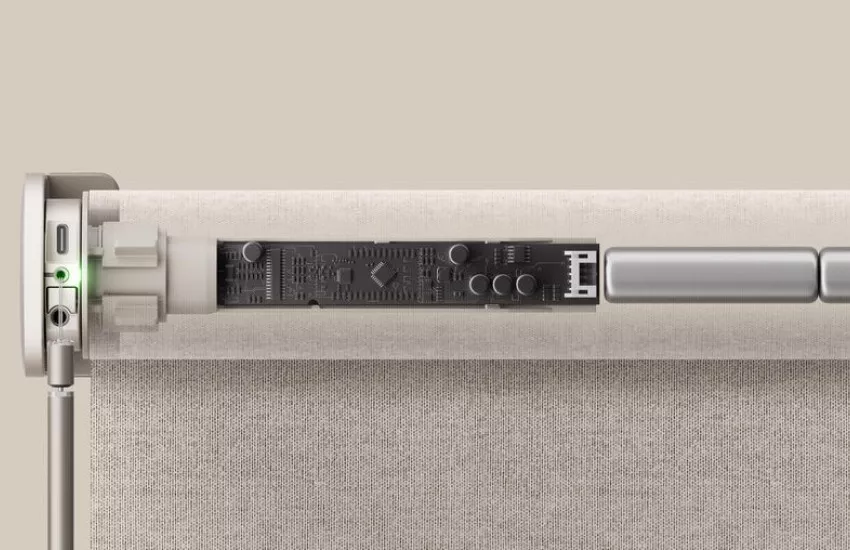
Motionblinds occupies a different position: mid-premium pricing with Matter and Thread built directly into Eve Motionblinds motors from the factory, so there's no bridge purchase required for that tier the way there is with Somfy or Lutron. Motionblinds motors also run up to 15 dB quieter than standard motorized systems, engineering recognized with the Best of the Best award for Absolute Silence at the R+T Asia Innovation Awards. Setup takes about a minute with no app account, and the system runs on local control with nothing leaving the home.
The one brand that looks cheaper but solves a different problem
SwitchBot deserves a fair look because it genuinely is the lowest-cost way into smart shading, and its new Hub 3 is a real upgrade, adding Matter 1.3 and local Thread execution that its older Hub Mini and Hub 2 didn't offer. For renters or anyone with existing horizontal blinds who just wants slat control, that's a legitimately good, budget-friendly option.
But SwitchBot Blind Tilt only rotates the slats of horizontal blinds. It cannot raise or lower a shade, and it doesn't work with roller, cellular, roman, or vertical blinds at all. Anyone comparing it to Motionblinds, Somfy, Hunter Douglas, or Lutron Serena on price is comparing two different product categories, not two versions of the same solution.
Matching your budget to the right brand
If you have existing horizontal blinds and only need slat control on a tight budget, SwitchBot's budget-tier pricing is hard to beat for that specific job. If fabric quality and design are the priority and budget is flexible, Hunter Douglas remains unmatched, understanding that you're buying finished shades, not a motor system, though Motionblinds pairs comparable fit-and-finish with a far simpler setup and local, private control instead of a cloud account.
If you want professional-grade reliability and don't mind a proprietary hub, Somfy's installer network and Lutron Serena's quiet motor performance are both strong choices in the premium tier. If you want full raise-and-lower automation across any blind type with native Matter and Thread and no required bridge purchase, Motionblinds occupies the middle ground on price with the most open connectivity story of the group.
Compare Bluetooth, Bridge, and Matter-over-Thread connectivity in detail at motionblinds.com/blog/smart-window-coverings-compared-motionblinds-bluetooth-vs-bridge-vs-eve.
Frequently ask questions - How much do smart blinds cost?
motors in the mid-to-high tier and requires a TaHoma hub for smart home integration, while Lutron Serena sits in the premium tier with a required Smart Bridge for platforms outside its own ecosystem. Motionblinds sits in a comparable mid-premium range but includes Matter and Thread natively in its Eve Motionblinds motors, avoiding a separate hub purchase that both Somfy and Lutron require.
For its specific function, yes. SwitchBot's budget-tier Blind Tilt only rotates th e sla ts of horizontal blinds you already own and can't raise or lower a shade. It solves a narrower problem than a full motor ized system, so the price difference reflects a difference in capability, not just brand positioning.
Hunter Douglas sells finished, made-to-measure shades at the luxury end of the category with unmatched fabric selection and design quality, not standalone motors. Motionblinds, by comparison, is engineered as one integrated motor system with native Matter and Thread, setup in about a minute with no account required, and local control that keeps everyday operation off the cloud.
It does meaningfully. Hub 3 adds Matter 1.3 support and local Thread execution, which the older Hub Mini and Hub 2 didn't offer. It's a real improvement, though it doesn't change SwitchBot Blind Tilt's core limitation of tilt-only control on horizontal blinds.
Somfy, with more than 50 years in the market and the largest professional installer and dealer network in the US, particularly strong in commercial and large-scale residential projects.
Most do in some form. Somfy needs TaHoma, Lutron Serena needs a Smart Bridge, Hunter Douglas needs a PowerView Gateway, and SwitchBot needs Hub 3 for Matter. Motionblinds needs the Motionblinds Bridge only for its Bluetooth motors; Eve Motionblinds motors connect natively with no Motionblinds bridge required.
This article reflects information available in July 2026 and is accurate to the best of our knowledge. Product specifications, platform integrations, and third-party brand features are subject to change without notice. We recommend verifying current details directly with manufacturers before making a purchase decision.
Related blogposts