Best Smart Blinds for Energy Efficiency in 2026
How automated window coverings reduce heating and cooling costs year-round
Read this within a minute
What's the news?
-
According to the U.S. Department of Energy, about 76% of sunlight that falls on standard double-pane windows enters to become heat — making window coverings one of the most direct ways to manage indoor temperature and reduce energy costs.
-
Black-out honeycomb shades with a built-in aluminium layer have been shown to reduce winter heat loss by 46% and summer heat absorption by 78%, with potential annual energy cost savings of up to 12%.
-
Motionblinds' own research into sustainable buildings indicates that dynamic automated shading systems can reduce cooling energy use by up to 30% and heating demand by 14%, with potential overall HVAC savings of over 20%.
What you need to know
-
According to the U.S. Department of Energy, about 30% of a home's heating energy is lost through windows — making window coverings one of the highest-impact energy upgrades available.
-
Honeycomb shades are available in different cell sizes and layer configurations — larger or multi-layered cell structures provide stronger insulation and are a strong choice for colder climates or rooms with large glass areas.
-
Motionblinds supports a full range of insulating fabrics across its complete product range including roller, honeycomb, pleated, Roman, and vertical systems.
-
Automated schedules responding to sunrise, sunset, temperature, and window orientation can deliver significantly greater energy savings than manual operation of even the best insulating fabrics.
-
Motionblinds enables responsive local automation that can run even during internet outages.
-
Results vary by climate, window orientation, fabric choice, installation quality, and usage patterns.
Key takeaways
- Energy efficiency from smart blinds comes from two things working together: the right insulating fabric for your climate and window orientation, and automation that ensures the blind is in the right position at the right time — without you having to think about it. Either element alone delivers partial results. Combined, they can deliver the full energy benefit that both fabric research and Motionblinds' own building data suggest.
- This guide is for homeowners, renovators, and energy-conscious buyers who want to reduce heating and cooling costs with window coverings that work intelligently around the clock — not just ones that look good in a spec comparison.
Why windows are your home's biggest energy liability
Most homeowners prioritize insulation, HVAC upgrades, and appliances when addressing home energy efficiency — and overlook the one surface responsible for a large share of thermal loss and gain in the building. According to the U.S. Department of Energy, about 30% of a home's heating energy is lost through windows — and about 76% of sunlight that falls on standard double-pane windows enters to become heat. For homes with older or single-pane glazing, the impact can be even more pronounced.
In summer, that incoming solar heat can rapidly raise room temperature, forcing air conditioning to work harder and run longer. In winter, the same glass radiates warmth outward overnight, increasing heating demand significantly.
Addressing this energy liability works best when two things are combined. The right insulating fabric reduces heat transfer passively. Smart automation ensures that fabric is deployed at the right time — capturing winter warmth when the sun is out, blocking summer heat gain before a room overheats, and retaining warmth overnight when temperatures drop. Fabric without automation delivers partial results. Automation with the wrong fabric limits how much the system can achieve. Getting both right is what drives the energy savings that research and real-world building data consistently suggest.
Choosing the right fabric for your climate and windows
Fabric choice is the foundation of energy-efficient smart shading — and not all fabrics perform equally. Understanding the differences helps match the right product to each room's specific energy profile.
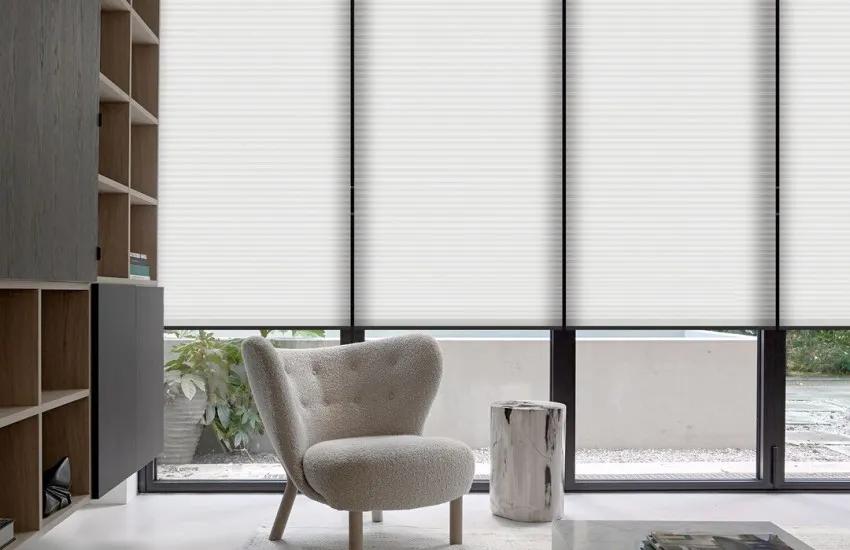
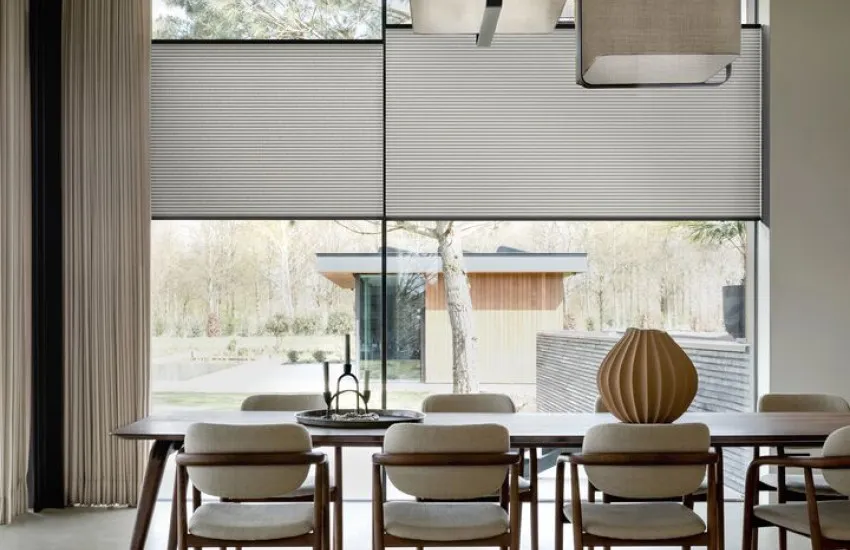
Honeycomb shades are among the most thermally effective window coverings available. Their unique cellular structure traps air to create an insulating barrier between the window and the room. Black-out honeycomb shades with a built-in aluminium layer deliver the strongest performance — shown to reduce winter heat loss by 46% and summer heat absorption by 78%, with potential annual energy cost savings of up to 12%. This combination of insulation and solar reflection makes them a strong choice for any room where temperature stability is a priority.
Honeycomb shades are available in different cell sizes and layer configurations. Larger or multi-layered cell structures provide stronger insulation and are a strong choice for colder climates or rooms with large glass areas. Smaller cell structures suit warmer climates where summer heat blocking is the primary goal. All honeycomb fabrics are available in translucent, light filtering, black-out, and flame-retardant options to match any room's energy, light, and safety requirements.
Black-out roller shades are a strong option for rooms receiving intense direct sunlight, delivering significant solar blockage when closed. They work particularly well in a double roller configuration — one black-out layer for overnight insulation and complete privacy, one solar or light filtering layer for daytime heat management without losing the view. Motionblinds offers a dedicated Double Roller product designed for this combination.
Light filtering shades offer a balance of insulation, daylight, and privacy well suited to living areas where complete black-out isn't required. They reduce heat transfer while maintaining a connection to natural light — a practical choice for family rooms and home offices that need comfort without darkness.
Motionblinds supports all of these fabric types across its complete product range — roller, double roller, honeycomb, pleated, Roman, Venetian, vertical, and curtain systems — giving homeowners the flexibility to match the right fabric to each window's specific energy and light requirements.
How automation turns good fabric into consistent savings
Fabric provides the insulating potential. Automation is what converts that potential into real, consistent energy savings — every day, without any manual effort.
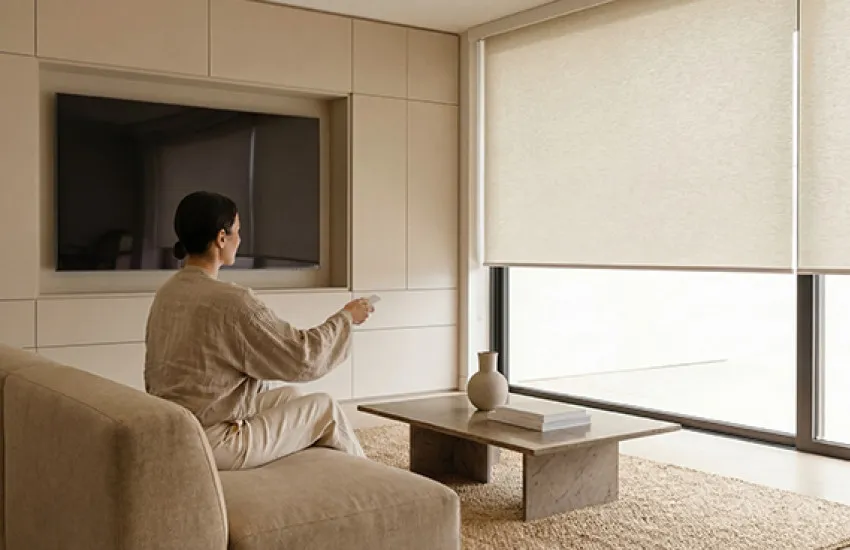
The best honeycomb shade in the world only saves energy when it's in the right position at the right time. A sun-facing living room shade that a homeowner manually closes on warm afternoons saves some energy. The same shade on a Motionblinds motor that closes automatically when indoor temperature begins to rise, reopens when the sun moves off the window, and closes again at sunset to retain warmth — can save significantly more, every day, including when nobody is home.
Motionblinds' own research into sustainable buildings suggests that dynamic automated shading systems can reduce cooling energy use by up to 30% and heating demand by 14%, with potential overall HVAC savings of over 20%. These figures reflect real-world automated operation, not manual use of the same fabrics — automation is what unlocks the full energy benefit. For more detail on how Motionblinds approaches energy-efficient building design, see our smart shading for smart shading for sustainable buildings guide.
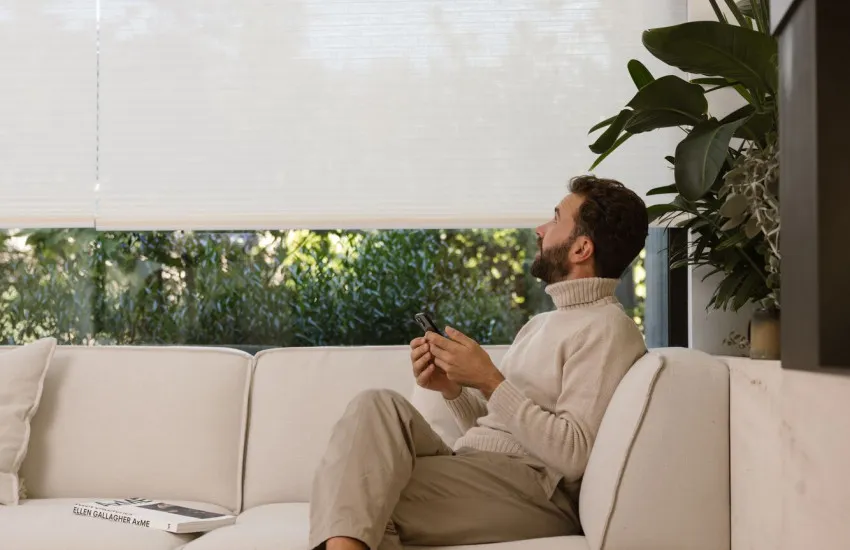
Eve Motionblinds connects to Apple Home, Google Home, Amazon Alexa, Samsung SmartThings, and Home Assistant via built-in Matter and Thread — no Motionblinds bridge required. This enables temperature-triggered automations, sunrise and sunset scheduling, and scene-based routines that run locally on the Thread network. Because Thread operates as a local mesh, energy automations can continue running reliably during internet outages. For homeowners who prefer the Wi-Fi Bridge approach, full automation including Google Home, Alexa, SmartThings, and Home Assistant integration is available through the Motionblinds Bridge.
Practical automation routines by window orientation
The most effective energy routines depend on which windows in your home face the sun. This varies by location — in Europe, North America, and northern China the sun travels across the southern sky; in Australia, New Zealand, and South Africa it crosses the northern sky. East and west behave the same everywhere.
Sun-facing windows deliver the highest energy impact. In Europe, North America, and northern China this is your south-facing window. In Australia, New Zealand, and South Africa it's your north-facing window. In summer, schedule closure by late morning and reopen in the late afternoon. In winter, open these blinds on bright days to capture free solar warmth and close at sunset to retain it overnight.
West-facing windows can cause significant evening overheating regardless of location. Scheduling closure by early afternoon in summer helps prevent heat buildup and can reduce air conditioning runtime during peak hours.
East-facing windows bring morning sun everywhere. Open them for natural light and warmth in the morning, close them before midday in summer to help limit heat gain.
Shade-facing windows — north-facing in Europe and North America, south-facing in Australia and New Zealand — receive no direct sunlight. Fabric choice matters more than automation here. Multi-layered honeycomb shades are a strong option for reducing overnight heat loss.
Honeycomb shades can typically reduce heating and cooling costs by 10–30% depending on climate, window type, fabric choice, and usage. The right fabric combined with orientation-specific automation has the potential to deliver results toward the higher end of that range.
Setting realistic expectations — what smart blinds can and cannot do
Smart motorized shades with the right insulating fabric can make a meaningful, measurable difference to heating and cooling costs — and both fabric testing and real-world building research support this consistently.
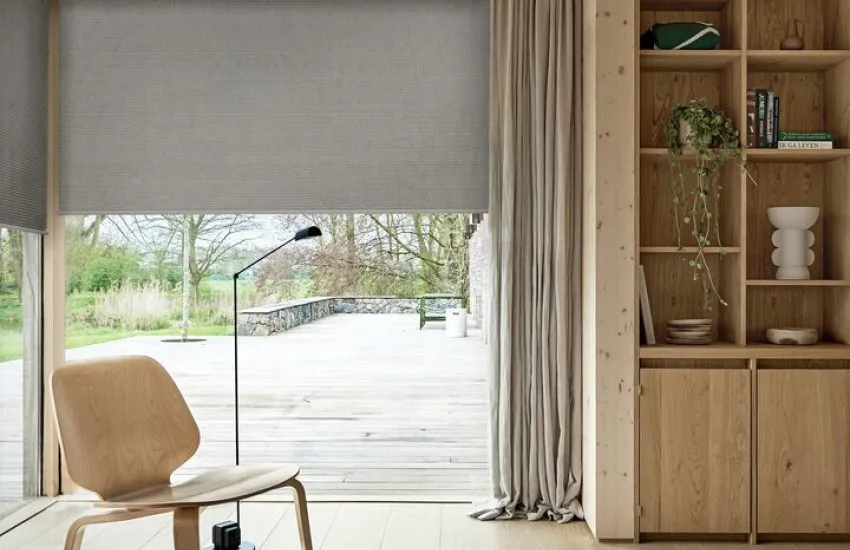
What smart blinds cannot do is replace structural insulation, address air leaks around window frames, or compensate for single-pane glazing in extreme climates. They work best as part of a broader energy strategy — alongside good glazing, proper sealing, and an efficient HVAC system. In that context they are one of the most accessible energy upgrades available, requiring no structural work and capable of delivering measurable results once installed.
The rooms that tend to benefit most are those with large glass areas, strong direct sun exposure, or significant temperature swings between day and night. A sun-facing living room with floor-to-ceiling glazing and a Motionblinds honeycomb shade on an orientation-matched automation schedule can show noticeable improvement in both comfort and energy use.
Frequently Asked Questions - Best Smart Blinds for Energy Efficiency in 2026
Results vary by climate, window orientation, fabric choice, and automation quality. Motionblinds' own building research suggests dynamic automated systems can reduce cooling energy by up to 30% and heating demand by 14%, with potential overall HVAC savings of over 20%. Honeycomb shades can typically contribute to heating and cooling cost reductions of 10–30% depending on the application.
Black-out honeycomb shades with a built-in aluminium layer show the strongest thermal performance — shown to reduce winter heat loss by 46% and summer heat absorption by 78%, with potential annual energy cost savings of up to 12%. Multi-layered or larger cell configurations are a strong choice for colder climates or rooms with large glass areas. Light filtering honeycomb shades offer a good balance of insulation and daylight for living areas. cation.
Yes. Motionblinds motors are compatible with the full honeycomb fabric range — including translucent, light filtering, black-out, and flame-retardant options in a variety of cell sizes. Both battery and hardwired motor options are available depending on installation requirements, through the Motionblinds dealer and fabricator network.
No. Automation based on sunrise, sunset, and time-of-day schedules can already deliver significant savings without a smart thermostat. Motionblinds also integrates with temperature sensors and smart thermostats across Apple Home, Google Home, and Amazon Alexa — adding real-time temperature response for additional efficiency — but scheduled automation alone can be highly effective.
Not with Eve Motionblinds. Eve motors have Matter and Thread built in and connect to all major smart home platforms without the Motionblinds bridge — just a compatible smart home hub from your preferred platform. For standard Motionblinds motors, the Motionblinds Bridge enables full automation including Google Home, Alexa, SmartThings, and Home Assistant integration.
Sun-facing windows tend to deliver the greatest energy impact — south-facing in Europe and North America, north-facing in Australia and New Zealand. Large glass areas and rooms that experience significant temperature swings between day and night also tend to benefit substantially from automated insulating shades.
Yes. The motor's power source affects installation convenience, not thermal performance. Energy efficiency is determined entirely by fabric choice and automation behavior. A USB-C rechargeable Eve Motionblinds motor on a black-out honeycomb shade delivers the same energy performance as a hardwired version — the batteries simply need recharging a few times per year.
Yes — scheduled automations can continue running reliably even during internet outages. Energy management routines can operate around the clock without depending on a cloud server or manufacturer's infrastructure.
Yes — and this is one of the key advantages of honeycomb fabrics specifically. In summer black-out configurations can reduce heat absorption by up to 78%. In winter they can reduce heat loss by up to 46% and can be opened strategically on bright days to capture free solar warmth. Honeycomb is one of the few window covering types that can deliver meaningful energy benefits in both heating and cooling seasons.
Related blogposts