Best alternatives to SwitchBot for smart blinds
Making the right choice for your smart home
Read this within a minute
What's the news?
-
SwitchBot is a popular entry-level smart blind gadget, but its Blind Tilt product controls only the tilt angle of slats and cannot raise or lower blinds
-
The smart blind market has matured significantly, with full motorized systems now offering Matter, Thread, and native smart home integration without proprietary hubs
-
Homeowners upgrading from SwitchBot or starting fresh have more purpose-built options than ever in 2025 and 2026
What you need to know:
-
SwitchBot Blind Tilt is a retrofit tilt controller, not a full motorized blind system — it cannot raise or lower window coverings
-
SwitchBot requires the Hub Mini or Hub 2 (sold separately) for any smart home platform integration or remote access
-
Matter-native alternatives like Eve Motionblinds and SmartWings offer full raise/lower control via Thread with local mesh networking
-
Somfy offers wide installer networks and established dealer support but uses one-way RF communication (RTS) and is not Matter-native
-
Lutron Serena delivers polished, premium performance but requires its own proprietary bridge and carries a high price per window
-
Motionblinds offers three connectivity levels — Bluetooth, Wi-Fi Bridge, and Eve Motionblinds with Matter and Thread built in — spanning every budget and integration need
Key takeaways
- SwitchBot fills a narrow but real niche: renters and budget-conscious shoppers who want basic slat-tilt automation without replacing their existing horizontal blinds. If that describes you, it works. But for anyone who wants full raise/lower control, child-safe cordless operation, deep smart home integration, or a system they can grow with, SwitchBot is not designed to compete.
- This comparison covers the most relevant alternatives across different buyer types — from renter-friendly retrofit options to full motorized systems built for long-term smart home investment. Every option has genuine strengths. The goal here is to match the right system to the right home.
Why people start looking beyond SwitchBot
SwitchBot built its reputation on affordability and speed. The Blind Tilt clips onto an existing Venetian blind's tilt wand, requires no drilling, and can be installed in under ten minutes. For renters who cannot modify their space, that ease of entry has real value.
The SwitchBot Blind Tilt controls the tilt angle of slats but does not raise or lower blinds. That fundamental limitation becomes a deal-breaker for anyone with roller shades, honeycomb blinds, Roman shades, curtains, or any window covering that moves vertically rather than tilting.
Smart home integration requires the SwitchBot Hub Mini or Hub 2, which must be purchased separately. Adding hub costs per household plus any scale-up across multiple windows pushes the total cost closer to purpose-built systems than the entry price suggests.
SwitchBot is also primarily a smart home gadget brand, not a dedicated window covering manufacturer. Its motor options are limited in product type, fabric choice, and smart home depth. Once a homeowner wants full raise/lower control, native Matter connectivity, or a wider range of shade styles, they are ready for something built to do more.
How to evaluate smart blind alternatives
The right alternative depends on what you actually need. A few key questions narrow the field quickly.
Do you need raise/lower or just tilt? Retrofit tilt motors like SwitchBot only work on horizontal slat blinds. Full motorized systems — roller, honeycomb, pleated, Roman, vertical, curtain — are a completely different category.
Do you rent or own? Renters need no-drill options. Homeowners building long-term smart homes benefit most from permanent motorized installations with deep integration.
Which smart home platforms do you use? Apple Home requires Matter or a compatible bridge. Google Home, Amazon Alexa, and Home Assistant each have varying levels of native support across brands. Proprietary ecosystems like Lutron require their own bridge regardless of platform.
How future-proof does the investment need to be? Matter and Thread represent the current smart home standard direction. Systems built on proprietary RF protocols or older Bluetooth stacks may face increasing friction with future platforms.
How much of your home are you automating? One room is a different decision than whole-home shading. Installer support, scalability, and per-window cost all shift depending on scale.
The strongest alternatives in each category
For renters who need more than tilt: The SOMA Tilt 2 offers solar charging and a quieter motor profile for horizontal blinds, though installation can be more involved depending on your blind rod type. It stays in the retrofit category but is a more refined gadget than SwitchBot.
For custom smart blinds with Matter: SmartWings offers made-to-order motorized shades with motor options spanning Zigbee, Z-Wave, Apple HomeKit over Thread, Matter over Thread, and Power over Ethernet. Users can choose from blackout or light filtering fabrics with custom sizing. The flexibility is genuine, though setup requires attention and some platform knowledge.
For premium performance: Lutron Serena is described by integrators as unmatched in reliability, with virtually zero response latency and batteries that can last over eight months. The trade-off is price – and the requirement for a Lutron Smart Hub.
For full motorized smart home integration at every level: Motionblinds offers three distinct connectivity tiers. Standard Bluetooth motors work for basic app and timer control. The Motionblinds Bridge adds remote access and integration with Google Home, Amazon Alexa, Samsung SmartThings, and Home Assistant. Eve Motionblinds builds Matter and Thread directly into the motor, enabling local mesh operation, native Apple Home support, and internet-outage resilience – with no Motionblinds bridge required (a compatible smart home hub from your preferred platform is still needed).

Why Motionblinds stands out in this category
The core advantage of Motionblinds is that it does not ask you to choose between simplicity and capability. The product line scales from a basic battery-powered blind managed with a smartphone app up to a full Matter and Thread installation that rivals anything on the market.
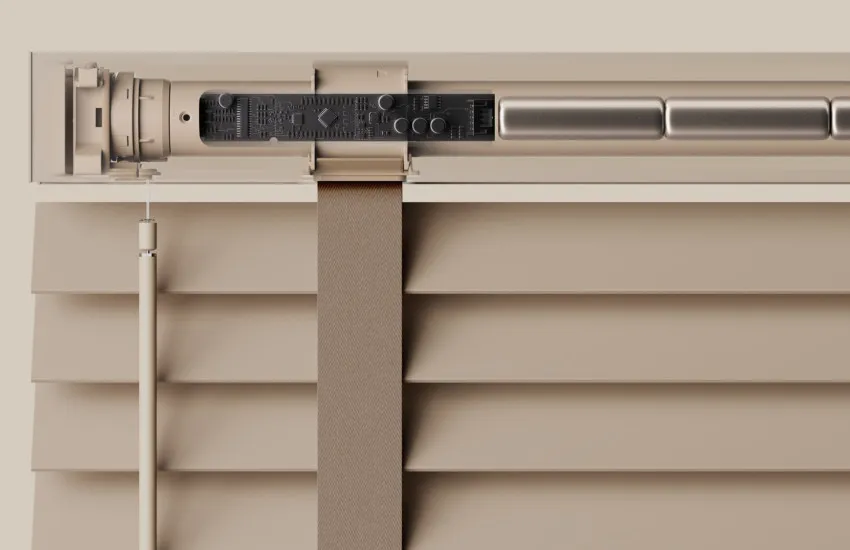
Motionblinds motors are engineered to run up to 15 dB quieter than standard motorized systems, with precision soft start and stop mechanics. The Eve Motionblinds model has Matter and Thread built directly into the motor – no Motionblinds bridge required for smart home integration. All data is stored locally on the motor, with no cloud dependency. The Thread protocol operates as a local mesh, which means the system continues working during internet outages.
The product range covers roller, double roller, honeycomb, pleated, Roman, Venetian, vertical, and curtain systems. The Motionblinds Upgrade Kit can retrofit most standard roller blind tubes, giving homeowners with existing hardware an entry point that does not require a full replacement.
For child safety, every Motionblinds product is cordless – meeting and exceeding the 2024 US and Canada cord ban requirements. The CPSC identifies corded blinds as one of the top five hidden hazards in American homes. That is not a minor point for families with young children.
Motionblinds has received the CES Innovation Award, the R+T Asia Innovation Award 2025 Best of the Best for Absolute Silence, and the Window Fashion VISION Readers Choice Awards 2025 for both Best Motor Manufacturer and Best Motorized Solution. It is also the official smart shading partner of Home Assistant.
Making the right choice for your home
SwitchBot is not a bad product for what it does. But the moment you want raise/lower control, child-safe operation, a full range of shade styles, or the ability to integrate deeply with your smart home platform of choice, you are looking for something SwitchBot was not built to be.
For renters on a tight budget who simply want tilt automation on existing Venetian blinds, SwitchBot or SOMA Tilt 2 remain practical options. For anyone else – owners, families, smart home enthusiasts, or anyone investing in window coverings for the long term – a purpose-built motorized system offers far more value per window.
Motionblinds specifically addresses the gap between entry-level gadgets and over-engineered proprietary systems. The Bluetooth tier keeps costs accessible. The Eve Motionblinds tier offers Matter and Thread that is as future-proof as the current smart home standard gets. And the range of supported blind types means you are not constrained to a single product format.
Explore the full Motionblinds connectivity range at motionblinds.com/smart-connectivity, or compare Bluetooth, Bridge, and Eve directly at motionblinds.com/blog/smart-window-coverings-compared-motionblinds-bluetooth-vs-bridge-vs-eve.

Frequently Asked Questions- Best alternatives to SwitchBot for smart blinds
SwitchBot Blind Tilt adjusts the tilt angle of horizontal slat blinds by rotating the tilt wand. It cannot raise or lower blinds. It is designed specifically for Venetian-style horizontal blinds with a rotary tilt bar between 6.2mm and 12mm. Any window covering that operates vertically — roller shades, honeycomb, Roman shades, curtains — is outside its compatibility entirely.
Most purpose-built motorized blind systems, including Motionblinds, are designed for DIY installation. The Motionblinds battery version requires no electrician. Somfy and Lutron Serena can benefit from professional fitting, particularly for hardwired configurations or complex multi-window setups. SmartWings ships blinds pre-assembled and pre-calibrated, with DIY mounting hardware included.
Eve Motionblinds has Matter and Thread built directly into the motor, making it natively compatible with Apple Home without any proprietary bridge. SmartWings also supports Apple HomeKit via Thread motor, though it requires a compatible Thread Border Router. Lutron Serena works with Apple Home via its Lutron Smart Hub.
Eve Motionblinds operates as a local mesh via Thread, which means it continues to function during internet outages. Standard cloud-dependent systems pause app control when Wi-Fi is down, though schedules and Bluetooth fallback may still operate depending on the brand.
Any system from the cordless motorized category meets current child safety requirements. Motionblinds products are cordless by design, meeting and exceeding the 2024 US and Canada cord ban requirements. The CPSC identifies corded blinds as one of the top five hidden hazards in American homes. SwitchBot Blind Tilt, as a retrofit tilt device, attaches to existing blinds — and those existing blinds may still have cords.
The Motionblinds Upgrade Kit can retrofit most standard roller blind tubes, which means you may not need to replace the entire blind. For other blind types, the motor is integrated into a new shade. If upgrading from a Motionblinds Bluetooth motor specifically, moving to Eve Motionblinds with Matter and Thread requires replacing the motor — the connectivity level is built into the motor hardware.
SwitchBot offers basic scheduling and platform integration via its hub, but is limited in the types of blinds it controls and does not support full raise/lower automation natively. Motionblinds at the Eve tier supports native Apple Home, Google Home, Amazon Alexa, Samsung SmartThings, and Home Assistant via Matter, with local Thread mesh networking, per-motor data storage, and no cloud dependency. The comparison is between a retrofit gadget and a purpose-built smart shading system.
Matter and Thread represent the current direction of the smart home industry, designed to work across platforms without requiring brand-specific bridges. Both Eve Motionblinds and SmartWings's Matter over Thread motor tier build this standard directly into the hardware, making them among the most future-proof options available today.
Related blogposts